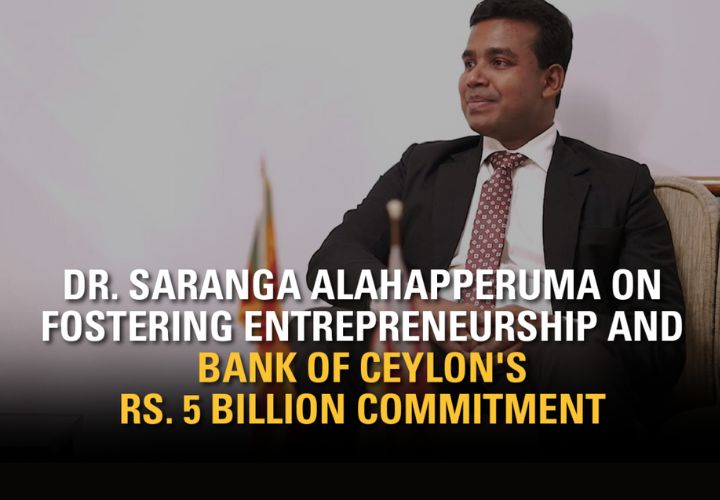
In a recent interview, Dr. Saranga Alahapperuma, Chairman of the Industrial Development Board, shared insights into the role of entrepreneurship in Sri Lanka's economic development. Dr. Alahapperuma highlighted the significant steps being taken to support small and medium-sized enterprises (SMEs), foster new entrepreneurs, and overcome the challenges faced by these businesses.
He also discussed the impactful collaboration between the Industrial Development Board and the Bank of Ceylon, particularly focusing on the bank’s recent Rs. 5 billion funding commitment to support young entrepreneurs.
Q: What are the primary issues contributing to economic challenges in Sri Lanka?
A: Eighty percent of the current issues in the country stem from insufficient income or poverty. A study in India revealed that during the post-harvest season, income increased by 60 percent, and IQ points rose by 14. This means that as people's income increased, their IQ points also went up. Therefore, as the Industrial Development Board, we believe that if this country's economic development is to occur, we must find solutions to these problems.
For that, we have initiated various projects aimed at eradicating poverty in our country. This cannot be achieved without clear artisanal foundations. In every country, entrepreneurs act as indirect forces in economic development. One cannot think about development without entrepreneurs. In resolving 80 percent of the country's issues mentioned earlier, government officials also have a role to play.
Q: How is the Industrial Development Board fostering new entrepreneurs and supporting SMEs?
A: The primary aim of our country is to create an environment conducive to crafts and entrepreneurs. We believe we can achieve this by increasing the number of entrepreneurs. We have focused on three main factors: creating an environment suitable for entrepreneurs and business people, generating new job opportunities through entrepreneurs, and paying attention to societal and policy formation.
A recent global study indicated that countries that make business operations easier tend to be economically prosperous, while those that make it difficult are often poor. Therefore, we are trying to simplify business operations.
In 2022, we launched a program for school entrepreneurs. Currently, more than 16,000 students from over 400 schools are successfully participating in this program. We provide training for students not just to get jobs but to create job opportunities. Students should be taught about earning money as they are taught other subjects.
Q: What are the main challenges faced by SMEs, and how is the IDB addressing them?
A: SMEs often face challenges in measuring their performance and overcoming growth barriers. The IDB supports these businesses in overcoming obstacles, and financial institutions play a key role in this process. Those thinking about starting a business often lack a proper place to seek advice. In the current system, it can take at least two years to get advice, leading to the abandonment of their business plans. This lack of proper environments is why the number of entrepreneurs is low in our country.
There are many success stories. When we ask those who have developed now, they mention having taken a 50,000-rupee loan from certain state banks 20 years ago. Those remaining are operating their businesses in very challenging conditions. Even in the current generation, many have smoothly cooperated with us after approaching us.
We have zonal managers in 25 districts who maintain ongoing contact with them. There are also those who have accessed export markets through the Bank of Ceylon's loan schemes. This is a gratifying development.
Q: How does the Industrial Development Board plan to enhance the competitiveness of Sri Lankan SMEs?
A: We aim to transform entrepreneurship into a social force. We have globalized women and new entrepreneurs. In collaboration with the Bank of Ceylon, we are operating under the Dream Youth Loan scheme provided by the bank.
Some entrepreneurs face difficulties in obtaining loans, taking up to two years to secure them. In this scenario, the Bank of Ceylon's initiative to provide loans up to 5 billion rupees from its bank fund is a commendable effort. Banks like this are essential for our country.
We have launched a sustainable entrepreneur development unit (SEDA startup) to address these issues. This is a five-day program covering various aspects like how to start a business, develop a business proposal, identify the market, register, and find and recruit assistants. We use a measurement scale in this program.
A micro-business remains at that level, and a small business stays small. It’s not just a measurement scale; we identify the problems faced by emerging entrepreneurs and support them with funding, technology, and market access. Additionally, we are creating an encouraging environment through this program. People often start businesses because they can't engage in other jobs. However, for people in developed countries, entrepreneurship is often the first choice. If entrepreneurship is given priority in our country, we can become a developed nation.
We are pursuing various initiatives to encourage entrepreneurs, including technological facilities, management, permit facilities, land for industrial zones, and creating local and international trade opportunities.
We also offer training. Information can be obtained by calling 1995, and the CEYLON PLAZA app is operational. We are advancing awareness programs, and the Bank of Ceylon is cooperating in all these projects, understanding the situation and providing support.
Q: How is the collaboration with financial institutions enhancing support for SMEs?
A : The government and IDB have allocated 50 billion rupees for loans. However, loans were not disbursed due to minor reasons. In this context, the Bank of Ceylon's effort to allocate 5 billion rupees for young entrepreneurs is a significant undertaking. This initiative will especially benefit the youth. The situation should change in the next 20 years. We look forward to offering our full cooperation to the Bank of Ceylon in this endeavor. We hope that other banks will also undertake similar initiatives to this project with the Bank of Ceylon.